
Know where a quota reading came from.
A useful quota number needs a source, a measurement time, and a clear account boundary. VibeBoard puts those details beside supported readings so you can decide whether to keep working or check the provider.
- Reading context
- Source, freshness, and available reset times
- Shared allowances
- One pool rather than a sum of client readings
- Missing data
- Explicit errors instead of an invented zero balance
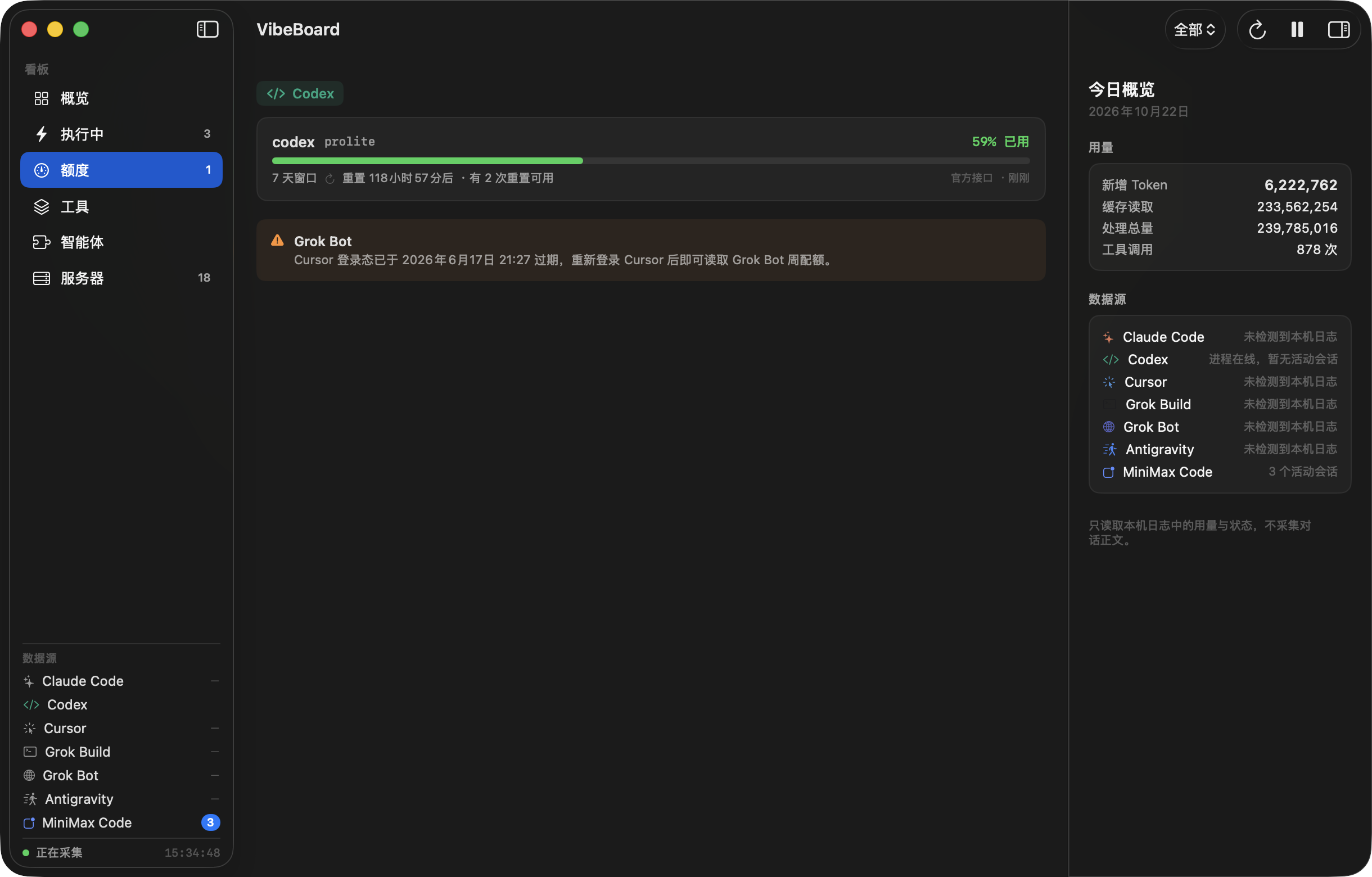
Account capacity differs from task tokens
A task’s token usage describes observed session work. A subscription window describes account capacity over a provider-defined period. They are not interchangeable, and having local usage records does not establish a remaining allowance.
Codex supports official quota readings and local records. MiniMax’s local data provides no subscription quota. DeepSeek Harness depends on readable sources; Cursor has limited shared subscription readings. Full remote quota for Claude Code and Antigravity is not implemented.
Read shared pools once
Grok Bot can show shared weekly quota and reset information from its cache and quota endpoint. When Build and Bot refer to the same X subscription, VibeBoard deduplicates them as one pool. Their client names do not represent independent allowances.
Multiple Codex sessions can also report account quota at different times. The latest account observation is the useful reading; adding sessions or accepting an older reading would misrepresent capacity.
Freshness and errors help you act
Check the reading time before planning around a quota card. Cached data keeps its original measurement time rather than becoming fresh when a file is opened. Reset information depends on the provider’s actual window or entitlement.
A missing credential, expired login, or failed endpoint should have an explanation. Unavailable does not mean zero remaining. Remote readings require a network connection and supported credentials; local monitoring alone cannot fill that gap.
Try this workflow on your Mac
Use the 3-day trial to check Quotas support with your own tools before choosing a one-time license for 1, 2, or 3 Macs. Waffo hosts checkout. Third-party AI subscriptions and model costs are separate.
Check the download page first: the 0.2.0 package uses machine-bound offline activation through support. Its online trial and self-service purchase activation are not enabled. Version 0.3.0 adds the online trial and website-license activation; check the download page for rollout status. Website license keys cannot activate 0.2.0.
Quotas questions
Why can task tokens appear without a subscription balance?
The two come from different data. MiniMax, for example, exposes local task usage without subscription quota in that local data.
Are Grok Build and Bot separate quota pools?
For the same shared X subscription, no. VibeBoard deduplicates their readings and uses the applicable measurement instead of adding them together.
What does an unavailable quota mean?
It means the source could not supply a usable reading. Read the explanation and timestamp; do not interpret it as zero remaining or a freshly measured balance.
Check your own setup.
Download the compatible package, read its activation notes, and verify a short workflow before relying on the dashboard.
Get VibeBoard for MacSetup documentation